12 May 2008

Soldier

Soldier: Birkholz — 353 Days in Iraq, 205 Days in Afghanistan

Soldier
Photographs by Suzanne Opton

Again: Lens Culture.The slideshow and the story, Here.

Now noch mal leben: portraits of the dying didn't bother me at all. This series made me a little sick to my stomach. Death is natural, and there is no reason to fear it. War, and the destruction of a young mind and body is not. Choices are made, and we possess the free will to alter our behavior. Pardon me, but this project, and the subsequent billboard project is a fucking stroke of genius. Visit Suzanne, here.
SoldierSocialTwist Tell-a-Friend

noch mal leben

Heiner Schmitz
age: 52
born: 26th November 1951
first portrait taken: 19th November 2003
died: 14th December 2003

Life Before Death
noch mal leben:
Portraits Of The Dying


Photographs by Walter Schels
Texts by Beate Lakotta

via: Lens Culture Slideshow: Here.Not for the faint of heart. This is now touring Europe. My wager would be that when it arrives here in the states, there will be some outcry and protest from the fanatics. I am comfortable with these, and I think this dude deserves some credit for taking on one of our most ferocious taboos in a direct, but sensitive way.
noch mal lebenSocialTwist Tell-a-Friend

11 May 2008

Julia Ward Howe (1819-1910)

Via Harvard University Library


While I intend to honor my mother and all the mothers of my family for everything they have done for me and for humankind, it bears noting that the original purpose of Mother's Day in the United States was charity and relief work during the Civil War by Anna Maria Jarvis, and anti-war activism and women's sufferage by Julia Ward Howe. You can read about it, here.
I will further point out that the irony will certainly NOT occur to most men, many women, and one certain Asshat who is celebrating his vacant-minded daughter's bethrothal this weekend at an "undisclosed" location in Texas. My guess is that he will wake up today with a clanging hangover, and have to visit his secret bottle of Jim Beam that is stashed in the toilet bowl tank. That is all.
Julia Ward Howe (1819-1910)
SocialTwist Tell-a-Friend

10 May 2008

Stashed Cards #024

The Neighborhood/Jerry Amerongen,1985


I wish I could hire Brad Shocker to come to my home twice a week.
Stashed Cards #024
SocialTwist Tell-a-Friend

09 May 2008

A Long Day In The Bluegrass


Main Street, Louisville. (1994) Nikon P-A-S/Fujicolor, and car-rooftop-as-a-tripod.

A horrific time was had by all, but man, the light was something.
A Long Day In The BluegrassSocialTwist Tell-a-Friend

My Brawling Washing-Bears

CRcarr, La Jolla, CA. (Wikimedia Commons)


When I first heard them, it was 3 in the morning. I literally thought that there was someone being murdered in the street. In all my years, I had never heard the Procyon Lotor fight. When I went out to investigate, the tree limbs were undulating wildly, and the screeching, wailing, and clicking was deafening. Apparently mating season comes a little late around here, because the brawling and trysting went on for most of April. Soon we'll have young'uns!
My Brawling Washing-Bears
SocialTwist Tell-a-Friend

05 May 2008

My First Ethics Lesson

Downtown Atlanta, 1975. Nikon F/TX400


It’s painful to look at this, but it was an important lesson on a bunch of different levels. I was 15 at the time, and really the first time out in a complex set of realities on my own. Sure, I had wandered around a Bluegrass festival and shot quaint pictures of Bill Monroe in Louisville and the like, but this was Downtown Atlanta. Big, foreign, and cold. Sure, when my uncle had his first post with the Ap in Detroit, I visited, went to the bureau, but I was never turned loose in downtown Detroit. It was an ugly place.

He was now a shooter and an editor in what was then a large hub for a number of states. I remember that some of his co-workers stowed their weapons in their lockers during work.

The long and the short of it is this: My uncle put a camera in my hand, and a wad of film, and said “good luck.” I came across these guys in the first day or so, and I thought I would try my luck. Before I could make any move, they asked me for money. I froze. I tried to think of what to do, and my brain just said, “give them a dollar and get it over with.” So I did. I had broken the cardinal rule dictating involvement with your subject. Secondly, you can see that I was tentative and scared to get close to them by the composition. The fellow on the right is unhappy. I don’t remember what he said or called me, but it wasn’t nice. That was the next to the last lesson of that day. The best was yet to come.

When that particular roll came out of the dryer, and the loupe was applied, the first thing I heard was, “you give them that dollar?”
My First Ethics Lesson
SocialTwist Tell-a-Friend

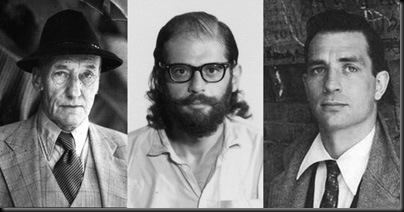
Thinking about the Beats

beattriptich400

“I saw the best minds of my generation destroyed by
madness, starving hysterical naked,
dragging themselves through the negro streets at dawn
looking for an angry fix,
angelheaded hipsters burning for the ancient heavenly
connection to the starry dynamo in the
machinery of night…” – “Howl” by Allen Ginsberg

“i find them largely tedious and often false. more on this later...” – Scott

William Burroughs. Allen Ginsberg. Jack Kerouac. Yes, they were self-indulgent, undisciplined, and sometimes down-right deconstructive. There were several Kerouac books that I started and never finished. Burroughs always struck me as grotesque and graceless in his prose. I loved Ginsberg.

I first read Ginsberg at the ripe old age of seventeen, and he was a revelation then. I understood “angelheaded hipsters burning for the ancient heavenly connection to the starry dynamo in the night.” It was like he was reading my mail. Whether the poetry was good or not, I wasn’t able to say. I had been schooled in all of the classic forms of poetry -- iambic pentameter, blank verse, free verse, haiku, the sonnet, and all that jazz, and it didn’t communicate to me at all, except if you were writing a song lyric and I didn’t do much of that.

For me, the Beat literature provided an unfiltered channel to the “counter-culture.” What we got from the mainstream media was a highly sanitized view of what was going on, even in rock music. The Beat literature had no such filters. I guess the cultural statement was more important to me than the quality of the literature or the veracity of the reporting. This was a genuinely different point of view powerful enough that people banned the books and charged the publishers with obscenity. It was powerful enough that the authors were willing to endure the critical abuse and legal harassment to publish it. It got my attention.

That alternative point of view included illicit drugs and forbidden sex, and it lit me up. I had never read “literature” like that before. Also, it contained something that came near to a justification for their reckless experimentation. They were like psychic astronauts blasting into the hostile reaches of the unconscious and the taboo. It was hedonistic, but the hedonism had a purpose – “Everything in excess.” It was as if some dark magical secret had been revealed.

In psychological time, that was a million years ago. I moved on to more grown-up tastes in poetry and literature, and eventually gave up poetry altogether because I became convinced that the only people reading poets were poets, and they did so begrudgingly, and I didn’t want to be limited to such a small audience that seemed to shrink every day.

In retrospect, the Beats do look careless, self-indulgent, dangerous to themselves and those around them, undisciplined and ultimately untenable. The same things that made them exciting wrecked their credibility. How do you take seriously a junkie queer who murdered his own wife playing “William Tell” with a handgun? Do you want to freeze to death counting railroad ties in Mexico, loaded up with booze and Secobarbital at the ripe old age of 46 like Neal Cassady? There can be little doubt that the critical ridicule faced by Kerouac hastened the end of his life. Ginsberg weathered the storm better than the others, but he did it by replacing the drinking and drugging with his version of Buddhism. I did some exploration into Buddhism but realized early on that I wasn’t cut out to be a Zen master. What do you do with the legacy of the Beats?

I know that for me, at a particular moment in time, they were vitally important. Their work was like a window on a strange and alien world that fascinated me. Maybe I’m secretly glad that they did what they did so that I didn’t have to do it. They showed us where the trapdoors were by falling through them. More importantly, they seduced us into launching our own psychic space probes. They had a real impact.

Thinking about the BeatsSocialTwist Tell-a-Friend

For blacklarsson

Kevin Pope, 1986. Collected 1987.


In hopes of triggering a chuckle or a smile.
For blacklarsson
SocialTwist Tell-a-Friend

Stashed Cards #023/
"Oooooo!"

Gary Larson, 1982. Collected 1986'ish.


Now I thought that I this one was timely back then, but then again...
Stashed Cards #023/
"Oooooo!"
SocialTwist Tell-a-Friend

03 May 2008

Them Deep Ellum Blues

Jimmie Revard and His Oklahoma Playboys


The first time I heard Deep Ellum Blues, was around 1990. I was collecting pre-war Country and Blues 78’s, and my first honest-to-god pre-war depression record was a buff Bluebird, (Victor’s depression label that sold for 35 cents each), by Jimmie Revard and His Oklahoma Playboys . I was so fascinated, that I played that thing over and over on an old Califone record player I bought at a school board auction. It had a preamp tube, a 6” speaker, and would play 33, 45, and 78rpm. I played that record so much in fact, that my girlfriend threatened to break that precious disc of shellac across her knee. The irony though, was that she was a pretty devoted Deadhead, and had she done her homework, she would have found a great version of Deep Ellum Blues in the Grateful Dead catalog. The point of all this, is that music recorded from 1925-1936, especially Country, String, Jug, and Blues, is priceless. And Deep Ellum is on my list of places to see before I die.
Them Deep Ellum Blues
SocialTwist Tell-a-Friend

My Great-Uncle was a G-Man

Mom, Sigrid, and cousins
in front of Uncle Tom's FBI car. (1944)


Recently, my mom’s first cousin Tommy started sending a flurry of emails regarding the Everson branch of the family, and this gem popped-up. I never really knew that we had a Fed in our family. It’s quite an ironic contrast to his brother, my free-wheeling, party monster and beloved grandfather Les. Aunt Sigrid is the one wriggling, and out of focus in the foreground. I am pretty anxious to hear more about the census information he’s turned up. This was triggered in part by Syd's recent post, "Uncle Doug's Spurs", over yonder.
My Great-Uncle was a G-Man
SocialTwist Tell-a-Friend

01 May 2008

Inner Fires

inner-fires The inner fires were hot then. It meant not sleeping at night and doing things that we would later try to block out of our memories. That doesn’t work, by the way. We pulled some capers that I still don’t like to talk about, most of which had something to do with getting naked and exploring the Dark Side. It felt good at the time — not truly relief, but a respite from conscious identity. We read Blake, tantric yoga, Kerouac, Hunter Thompson, William Burroughs and every other wild-ass we could get our hands on.  It was a hell of a party. I’m sorry you missed it...

for the rest of the story, click here

Inner FiresSocialTwist Tell-a-Friend

23 April 2008

Vanishing Farms

vanishingfarm640 I like farms. I have never lived or worked on one, but that’s just because my life didn’t take me in that direction, not because I didn’t like them. I was up in Indiana, in what used to be a rural area, and saw this scene. I had to stop the car and shoot it: a beautiful old farm sliced up and sold off to build more suburban sprawl. While food prices double and triple, our destruction of farms keeps pace. I know people need a place to live, but we also need food and fresh air.

America seems to be very short-sighted right now. We kill off our farms and ship our jobs overseas so that we can buy cheap crap at Wal-Mart. Where do you think that takes us? It isn’t to greater prosperity and security; I can tell you that. If I had a bunch of money, I would be buying farm land and I wouldn’t be dividing it up for subdivisions and strip malls. I have yet to see a strip mall I couldn’t live without.

Vanishing FarmsSocialTwist Tell-a-Friend

11 April 2008

Bread Kitchen at Shakertown

Shakertown3_640

This is one of the most cosmic places in all of Kentucky. It's the Shaker village at Pleasant Hill. The Shakers were a religious group who believed that the end of the world was coming soon. They built communities which were beautiful and austere where they lived lives of celibacy and devotion. The interesting thing is that the men and women got together for ecstatic dances, and some of their spirit-filled movements gave them their name, Shakers. But there was no sex. They danced, but no romance was allowed. The Shaker communities were like co-ed monasteries. Predictably, they died off. Their buildings are still here, and we're still here, but the Shakers are gone.

Bread Kitchen at ShakertownSocialTwist Tell-a-Friend

07 April 2008

R.I.P. Philip Jones Griffiths 1936-2008

IMAGE: ©2008 Alice Smeets

There is not much to say other than read on, and view his work. It is pretty much covered in this Spring 2008 interview with Aperture: here, and a tribute on Magnum's blog, here. Many thanks for the image of PJG from Alice Smeets.

"Not since Goya has anyone portrayed war like Philip Jones Griffiths."
-Henri Cartier-Bresson
R.I.P. Philip Jones Griffiths 1936-2008
SocialTwist Tell-a-Friend

03 April 2008

PHOTOGRAPHERS-I BILL GATES-O

$834,000.00 is just a lonely bead of sweat on the brow of "Monopoly-Bill, The Boy Genius". It may be a small and inconsequential as far as money goes, ($834,000.00 for 67,640 lost images, the defendant being Corbis, (wholly owned by Bill Gates), and the plaintiffs being Arthur Grace and Chris Usher), but the real significance lies in the message the judgment sends to those who have lost, cheated and stolen images from photographers since the beginning of time. Forever, individuals, corporations, and agencies like Corbis, have underpaid, minimized and abused photographers, while maintaining that their images are common property, have little value, or not really "intellectual property"at all. Read about this stuff, here.
PHOTOGRAPHERS-I BILL GATES-O
SocialTwist Tell-a-Friend

02 April 2008

"Fuck You. The Law Doesn't Apply To Me"


Memo: Laws Don't Apply to Interrogators

Justice Dept. Official in 2003 Said President's Wartime Authority Trumped Many Statutes

By Dan Eggen and Josh White
Washington Post Staff Writers
Wednesday, April 2, 2008; Page A01

The Justice Department sent a legal memorandum to the Pentagon in 2003 asserting that federal laws prohibiting assault, maiming and other crimes did not apply to military interrogators who questioned al-Qaeda captives because the president's ultimate authority as commander in chief overrode such statutes. [It is assumed, that this is precisely what Spc Alyssa R. Peterson's orders included.]

Read the entire story: here. (See also: Madness In The Desert, from March 21 & 22, on this blog)
"Fuck You. The Law Doesn't Apply To Me"SocialTwist Tell-a-Friend
Related Posts with Thumbnails

...................................